
Let me clear something up right away. Spanish moss is not Spanish, and it is not moss. It’s a flowering plant — Tillandsia usneoides — a member of the bromeliad family. That makes it a distant relative of the pineapple. I mention this on tours and watch people visibly recalibrate everything they thought they were looking at.
It’s also not killing the trees. Spanish moss is an epiphyte — it uses the tree for structural support only. It pulls everything it needs directly from the air and rain. So the trees it drapes over are not being parasitized. They’re just providing a place to hang.
So What Is It Actually Doing?
Spanish moss absorbs moisture and nutrients directly from the atmosphere. It does this through tiny scales called trichomes. Specifically, it has no root system attached to the tree at all. Instead, it anchors itself with a thin holdfast, hangs down, and photosynthesizes. A healthy live oak handles Spanish moss the way you’d handle wearing a scarf. Barely noticeable.
Why Does It Only Grow on Certain Trees?
Live oaks and bald cypresses dominate in Savannah for two reasons. First, their rough bark provides good purchase. Second, their pH tolerates the moss well. Beyond that, humidity matters enormously. Savannah sits at sea level, surrounded by tidal marsh. As a result, the city produces the persistent atmospheric moisture Spanish moss needs. The moss and the geography are perfectly matched.
Historical Uses You Probably Don’t Know
Spanish moss was commercially harvested throughout the 19th and early 20th centuries. Workers removed the gray outer scales through a process called “ginning.” The dark inner fibers then stuffed mattresses, furniture, and early automobile seats. In fact, Ford used them in Model T seats. Additionally, Indigenous peoples used the moss for insulation and nesting material. Gullah Geechee communities of coastal Georgia relied on it medicinally for generations.
What It Means to This City
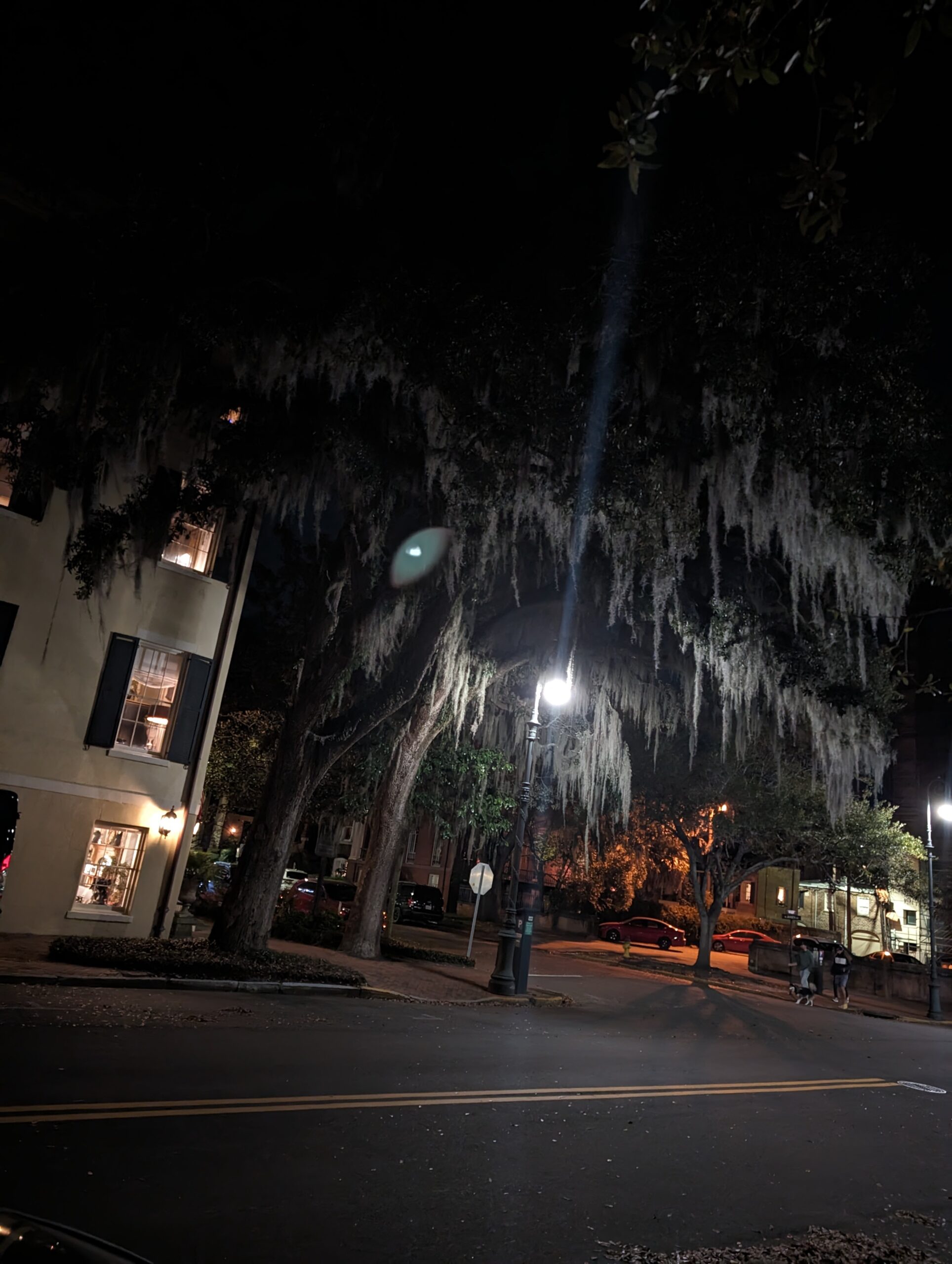
Savannah without Spanish moss is essentially a different city. The way it filters late-afternoon light in the squares is remarkable. The way it catches the river breeze on humid summer nights is unmistakable. It’s as much a part of Savannah’s atmosphere as the cobblestones on River Street. Or the smell of the marsh at low tide.
Next time you walk under the oaks, look closely. It flowers from spring through summer. The blooms are tiny and pale blue-green. Almost everyone misses them while photographing the tree overhead. That feels very Savannah to me.
Experience Savannah In Person
Did you find this story intriguing?
Are you ready to experience Savannah in person?
Join me on the ghost tour I’ve been leading for over a decade — real history, real paranormal research, and the stories that don’t make it into the guidebooks. Small groups. No scripts. Just Savannah.
Select your date below — instant confirmation, full refund up to 24 hours before the tour.
🔒 Secure booking · Powered by FareHarbor · $39/person
Prefer to browse first? See all 5 tours →